

Regional Geochemistry-National Reconnaissance Proj
In 1951, Mr. Xie Xuejin, a pioneer and founding figure of geochemical exploration in China, conducted the first geochemical exploration experiment in the country, marking the beginning of China’s geochemical exploration. In 1978, he proposed the "Regional Geochemical Survey National Scanning Plan," which became the longest-running (since 1978 to present), largest in coverage (7 million square kilometers), most systematic in technology (from sampling to analysis to map preparation and interpretation), and most successful in mineral exploration (discovering over 2,570 mineral deposits) regional geochemical mapping project that combines research and survey. This plan established China’s leading position in international geochemical mapping.
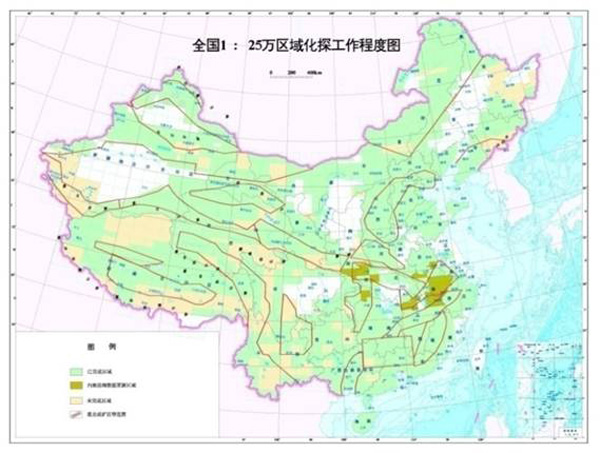
Regional Geochemical Survey Coverage Map, which has now covered over 7 million square kilometers of the country
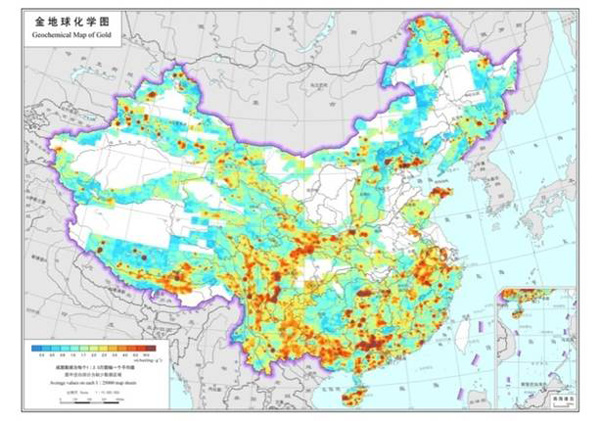
China's Gold Geochemical Map, created based on the results of regional geochemical analysis
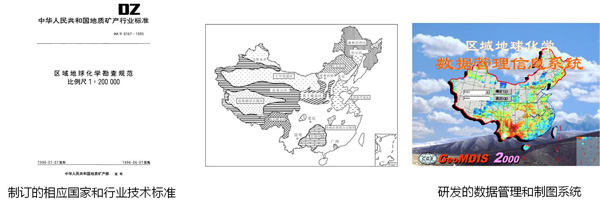
The plan achieved several systematic innovative results:
1. Developed field sampling methods suitable for various landscapes in China, and established corresponding national and industry technical standards.
2. Developed 39-element analysis systems and methods, which not only broke through some trace element analysis technologies but also achieved fast, low-cost, and large-scale sample analysis.
3. Prepared geochemical standard samples of water system sediments, soils, and rocks to monitor laboratory analysis quality, and established strict analysis quality control schemes.
4. Developed the "Geochemical Management Data Information System" (GeoMDIS) and the "Geoscience Exploration Processing and Logistics Data Management System" (GeoExpl) for managing and mapping massive regional geochemical data.
Regional Geochemical Survey is a fundamental, public geological survey that has become the most important basis and method for mineral exploration, work deployment, and resource potential evaluation in China. At the same time, the vast data obtained from these surveys provide new references for basic geological research, environmental, ecological, and agricultural studies. According to incomplete statistics, over the 35 years from the 6th Five-Year Plan to the 12th Five-Year Plan, 2,570 mineral deposits of various types were discovered through regional geochemical surveys, with major minerals being non-ferrous metals and precious metals. Among them, nearly 700 gold deposits of medium and large scale were found, with proven reserves exceeding 5,000 tons.
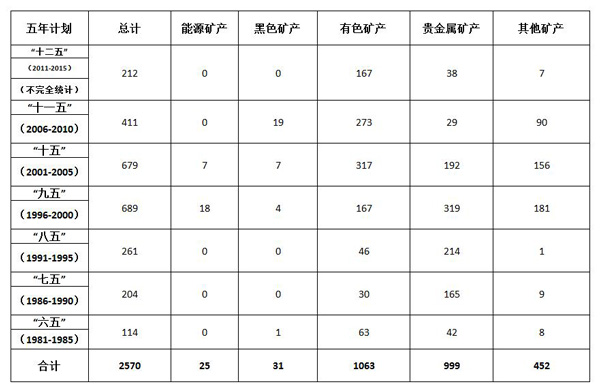
Mineral Discoveries in the Regional Geochemical Survey (1981-2015)
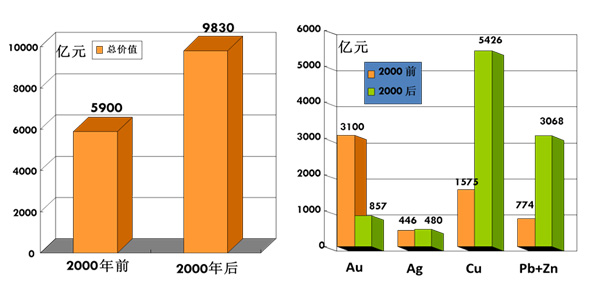
Economic Value of Different Types of Mineral Deposits Discovered by Regional Geochemical Exploration in China